Verified 2026 Pricing Data
8 Brutal WordPress Web Hosting Cost Truths That Stop Overpaying
The real 2026 WordPress web hosting cost across shared, VPS, managed, and dedicated tiers plus every hidden fee hosts hope you never calculate.
By the Hosting Research Desk · 16-minute read · Fact-checked against live 2026 provider pricing pages
WordPress web hosting cost looks simple on a pricing page and turns complicated the moment your first invoice arrives. That $2.95/mo banner is not the number you will actually pay, and most buyers only discover the real figure after their card gets charged.
This guide breaks the true cost down by tier, exposes the renewal-rate trap almost every host relies on, and settles the biggest argument in web hosting: is budget shared hosting a smart start, or a false economy next to premium managed hosting? We tested both sides against real 2026 pricing.
WHAT YOU’LL LEARN
- The advertised price is not the real price
- Four hosting tiers, four very different cost realities
- The hidden fees nobody puts on the pricing page
- Budget hosting vs. managed hosting — tested, transparently
- Your real 3-year cost, calculated in full
- Server performance, site speed, and your decision framework
Frequently Asked Questions
Quick Answer
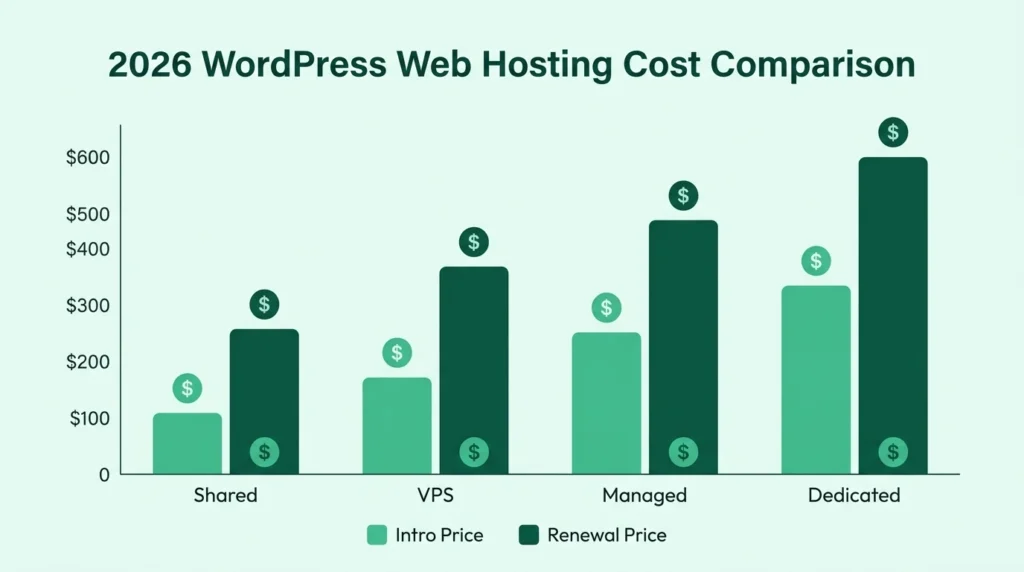
Realistic WordPress web hosting cost ranges from $36–$288/year for shared hosting after renewal, $132–$648/year for VPS hosting, and $300–$708/year for managed WordPress hosting. Add $10–$25/year for a domain and $0–$120/year for backups. Most “budget” plans renew 140%–350% above their advertised rate.
The Advertised Price Is Not the Real Price
Every low-cost host builds its homepage number around a multi-year prepay. Bluehost’s Basic shared plan starts at $2.95/mo on a 3-year term, then renews at $8.99/mo — a 205% increase the moment that term ends.
Pick the 12-month term instead and the jump is still steep: the Starter-tier plan begins at $4.99/mo and renews at $11.99/mo, a 140% increase in year two. VPS plans see the sharpest swings of all, with some renewal rates landing 350% above the promotional price.
What "Introductory Pricing" Actually Means
- The advertised rate applies only to your first billing term, typically prepaid for 12, 24, or 36 months
- Renewal pricing is set by the host and rarely appears next to the sign-up price
- Longer terms lower the monthly rate but lock in more cash before you know if the host suits you
- Cancelling before renewal can forfeit a "free" bundled domain or SSL certificate
This is standard practice across the industry, not a trick from any single company. Always ask for the renewal rate in writing before you buy, and budget for that figure — not the number in the ad.
Four Hosting Tiers, Four Very Different Cost Realities
“WordPress hosting” is not one product — it is four distinct infrastructure models, and the price gap between the cheapest and most expensive tier can top 2,000%. Here is what each tier costs using real, published 2026 pricing.
Shared Hosting: $2.95–$14.99/mo (Renews at $8.99–$23.99/mo)
Your site shares one physical server with hundreds of others. It is the cheapest entry point and a fair choice for a first blog or a low-traffic portfolio site.
- Bluehost Basic: $2.95/mo intro (3-year term) → renews at $8.99/mo
- Bluehost Choice Plus: $5.45/mo intro → renews at $14.99/mo
- Hostinger, SiteGround, A2 Hosting: commonly start near $2.99/mo
VPS Hosting: $11–$54/mo
A virtual private server gives you dedicated resources on shared hardware — a real middle tier for sites outgrowing shared hosting. Our VPS vs. shared hosting comparison breaks down the exact traffic point where this upgrade starts paying off.
- Cloudways on DigitalOcean, 1GB: $11/mo billed monthly, roughly $8.25/mo billed annually
- Cloudways on DigitalOcean, 2GB: $22–$24/mo, often the sweet spot for agencies running 5–15 client sites on one server
- Hostinger VPS: starts near $5.99/mo for developers comfortable managing their own stack
Managed WordPress Hosting: $25–$59/mo
The host handles updates, caching, and security tuning for you. This tier is the center of the industry’s biggest cost debate, tested transparently below.
- WP Engine Essential Startup: $30/mo annual billing, $40/mo month-to-month, capped near 25,000 monthly visits
- Kinsta Starter/Single: $30–$35/mo depending on plan, running on Google Cloud with 14-day backups included
- Liquid Web Managed WordPress: starts around $25/mo
Managed WordPress Hosting: $25–$59/mo
An entire physical server reserved for one client, typically reserved for high-traffic enterprise sites or agencies running dozens of properties. Expect setup fees layered on top of the monthly rate at this tier.
$36–$288
Shared hosting, real annual cost
58%
Average law firm bounce rate
58%
Average law firm bounce rate
The Hidden Fees Nobody Puts on the Pricing Page
The plan price is your entry fee, not your total bill. Three costs get left off almost every comparison chart, and together they can add $150–$400 a year to a “budget” WordPress site.
Domain Registration and Renewal
The wholesale cost behind a .com domain sits around $10.46/year, climbing toward $11.17/year once Verisign’s fee increase lands on November 1, 2026. Retail pricing runs far above that floor.
- GoDaddy: $4.99–$9.99 first year, renews at $21.99–$22.99/year
- Namecheap: around $6.79–$9.98 first year, renews near $13.48–$14.78/year
- Cloudflare Registrar: sells at cost, roughly $9.15–$10.44/year with no markup
If your registrar isn’t Cloudflare, expect a “free first-year domain” to renew at two to three times its wholesale cost. Our domain registrar comparison breaks down which providers keep that markup smallest over time.
SSL Certificates
Free SSL through Let’s Encrypt now ships with nearly every credible host, so paying extra here is usually unnecessary. Paid options still exist for businesses wanting extended-validation branding.
- Free (Let’s Encrypt): included automatically with most shared, VPS, and managed plans
- GoDaddy Deluxe Automated DV SSL: around $7.99/mo on a 3-year term, roughly $96 per term
Never pay extra for SSL on a standard business or blog site in 2026. Free, browser-trusted certificates are the default across the industry treat a host that charges for basic SSL as a warning sign, not a feature.
Backup Plugins and Security Add-Ons
- UpdraftPlus: free core version; premium plans start around $70/year
- Jetpack VaultPress Backup: $9.95/mo standard rate, about $119/year
- Bluehost CodeGuard add-on: $47.88/year Basic, up to $107.88/year Premium
- SiteLock malware scanning add-on: $95.88–$239.88/year per domain
Stack a domain renewal, a backup plugin, and one security add-on onto a $2.95/mo shared plan, and your “budget” site can quietly reach $250–$400 in year two alone.
Budget Hosting vs. Managed Hosting Tested, Transparently
This is the debate every WordPress site owner eventually faces: stick with $2–$5/mo shared hosting, or upgrade to $25–$35/mo managed WordPress hosting? We ran the actual numbers rather than repeating industry talking points.
Our Test Assumptions
- Site type: small business site or blog, 5,000–20,000 monthly visits
- Compared: Bluehost Basic shared plan vs. WP Engine Essential Startup managed plan
- Includes: hosting, one .com domain renewal, one backup solution, standard SSL
- Time frame: 24 months, past the introductory promo period
Where shared hosting wins: raw sticker price. For a hobby blog or a low-stakes personal project, $8.99/mo after renewal is genuinely hard to beat, and server performance rarely bottlenecks a site at that scale.
Where shared hosting loses: once you add a backup plugin, a security add-on, and factor in shared-server slowdowns during traffic spikes, the “budget” plan’s real cost climbs toward $250–$350/year — while still capping performance under load.
Our verdict: budget shared hosting is not a false economy for low-traffic personal sites — it’s the correct call. It becomes a false economy the moment your site earns revenue or depends on uptime, because one bad outage costs more than a year of managed hosting fees.
Your Real 3-Year Cost, Calculated in Full
Marketing pages show you month one. Here is the true 3-year cost once renewals, a domain, and basic backup coverage are included the number that should actually drive your decision.
What "Introductory Pricing" Actually Means
- Year 1 (promo rate): $2.95/mo × 12 = $35.40
- Domain renewal (years 2–3): ~$15/year × 2 = $30.00
- Years 2–3 (renewal rate): $8.99/mo × 24 = $215.76
- Backup plugin, years 2–3: $70/year × 2 = $140.00
- 3-year total: approximately $421
Managed WordPress Hosting: Real 3-Year Total
- Years 1–3 (annual billing rate): $30/mo × 36 = $1,080.00
- Domain renewal: ~$15/year × 3 = $45.00
- Backups, SSL, CDN, staging: included at $0 extra
- 3-year total: approximately $1,125
The gap is real — roughly $700 over three years, or about $11.70/month. For a revenue-generating site, that premium buys dedicated resources and built-in security most owners would otherwise pay for separately anyway.
Server Performance, Site Speed, and Your Decision Framework
Server Performance Is the Cost Nobody Prices In
Shared hosting throttles CPU and memory the moment traffic spikes, which is invisible on a pricing page but very visible in your bounce rate. According to Google’s Core Web Vitals documentation, site speed is a direct ranking and user-experience factor — meaning slow shared hosting can quietly cost you organic traffic on top of the sticker price.
Cloud and Per-Server Pricing Rewards Multiple Sites
Cloudways prices per server, not per site. An agency running 15 client sites on one 4GB server pays around $54/mo total — roughly $3.60 per site — dramatically cheaper at scale than paying per-site managed pricing. If you run a single site, this model works against you.
Migration and Downtime Have a Cost Too
Switching hosts sounds simple until DNS propagation delays and plugin compatibility testing eat into a weekend. Most managed hosts include free migration; budget hosts usually do not. Our step-by-step WordPress migration checklist covers how to avoid downtime during the switch.
How to Choose the Right Tier for Your Site
- Personal blog or hobby project → shared hosting is the right call
- Small business site with growing traffic → managed WordPress hosting pays for itself
- Developer or agency running several client sites → VPS or cloud hosting wins on cost-per-site
- WooCommerce store or high-traffic property → managed hosting or dedicated resources, never entry-level shared
Before comparing plans side by side, check our managed WordPress hosting comparison for a deeper breakdown of which provider fits each traffic tier.

Frequently Asked Questions
What is the average WordPress web hosting cost in 2026?
Most small sites land between $36/year on budget shared hosting and $420/year on managed WordPress hosting before add-ons. Including domain renewal and basic backups, a realistic all-in budget runs $120–$600/year depending on tier.
Why did my hosting renewal price jump so much?
You likely signed up during an introductory promotion. Nearly every budget host discounts the first term heavily, then bills the full renewal rate — sometimes 140%–350% higher — once that term ends.
Do I need to pay extra for an SSL certificate?
No. Free SSL through Let’s Encrypt is included with almost every host in 2026 and provides the same encryption a standard site needs. Paid SSL only matters for extended-validation business branding.
Is managed WordPress hosting worth $25–$35 a month?
For a revenue-generating or client-facing site, yes. It bundles backups, security, and performance tuning that would otherwise cost $150–$300/year in separate add-ons on shared hosting, while delivering faster load times.
What hidden fees should I budget for beyond the hosting plan?
Budget for domain renewal ($10–$25/year), a backup solution ($0–$120/year), and any security add-on your host doesn’t already include. Together these can add $150–$400 a year to a “budget” hosting plan.